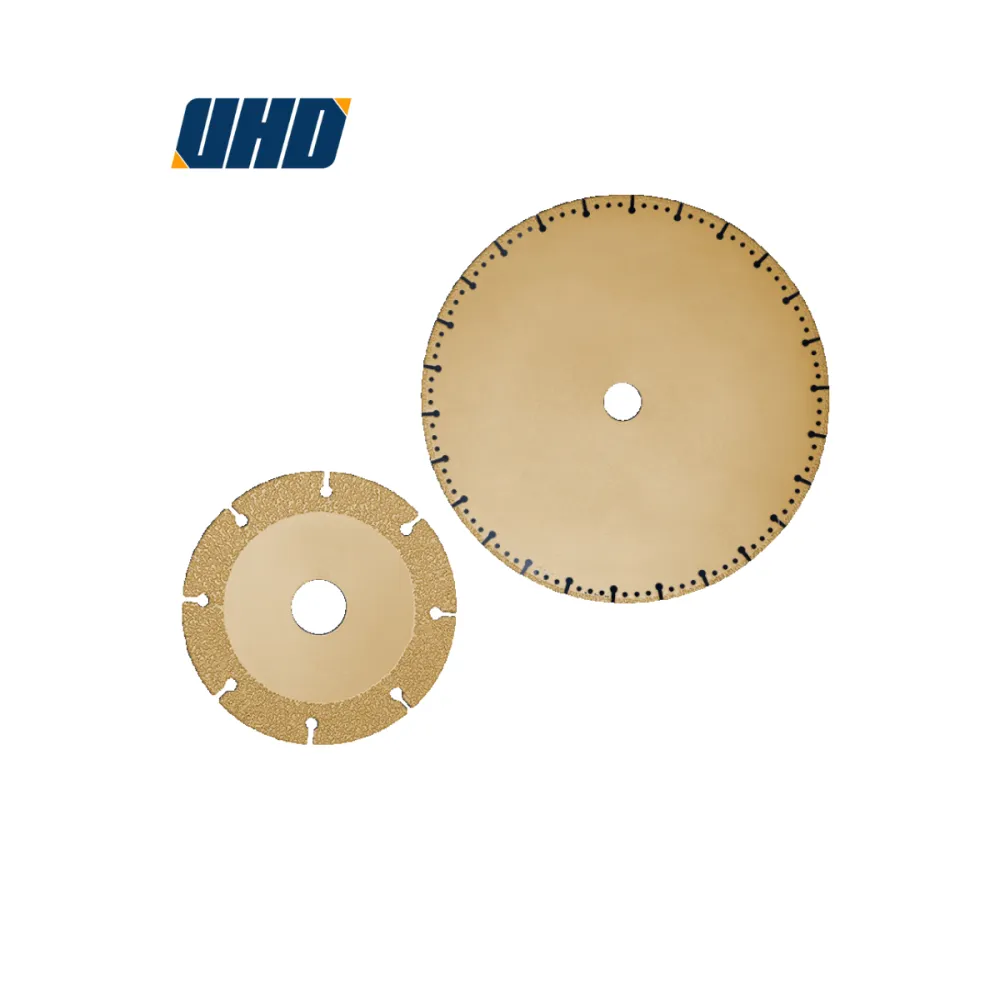
Vacuum brazing technology has emerged as a revolutionary method in the manufacturing of diamond cutting blades. At its core, this technology relies on a carefully controlled vacuum environment, the selection of appropriate brazing filler metals, and the precise adjustment of process parameters.
In a vacuum environment, typically maintained at a pressure as low as 10⁻³ to 10⁻⁶ Pa, oxidation and contamination are significantly reduced. This allows for a cleaner bonding surface between the diamond particles and the blade substrate. The choice of brazing filler metal is also crucial. For instance, filler metals containing elements like titanium (Ti) can form strong chemical bonds with diamond, enhancing the overall bonding strength.
One of the key advantages of vacuum brazing is its ability to achieve a high - strength bond between diamond particles and the substrate material. Through the optimized brazing process, the diamond particles are firmly embedded in the substrate, which can withstand the high - stress conditions during cutting operations.
Tests have shown that diamond cutting blades produced by vacuum brazing can have a wear resistance that is 2 - 3 times higher than those made by traditional methods. This means that the blades can maintain their sharpness and cutting performance for a much longer time, reducing the frequency of blade replacement and thus increasing the overall service life.
When compared to traditional brazing methods, vacuum brazing offers several distinct advantages. Traditional brazing often results in a relatively weak bond between the diamond and the substrate, which can lead to diamond particles falling off during cutting. In contrast, vacuum brazing reduces sliding resistance and extrusion damage.
For example, in a case study of a metal cutting application, traditional brazed blades showed a 30% decrease in cutting efficiency after 10 hours of continuous use, while vacuum - brazed blades only experienced a 10% decrease under the same conditions. This indicates that vacuum brazing can provide more stable cutting performance over time.
In industrial heavy - duty cutting scenarios, such as cutting thick metal plates or hard stone materials, the performance of cutting tools is of utmost importance. Vacuum - brazed diamond cutting blades have demonstrated excellent cutting efficiency and stability.
In a granite cutting project, a vacuum - brazed blade was able to cut through a 10 - centimeter - thick granite slab in 20 minutes, while a traditional blade took 35 minutes. Moreover, the vacuum - brazed blade maintained a more consistent cutting speed throughout the process, resulting in a smoother cut surface.
From an economic perspective, the use of vacuum - brazed diamond cutting blades can bring significant long - term benefits. Although the initial investment in these blades may be slightly higher, the reduced frequency of blade replacement and increased cutting efficiency can lead to substantial cost savings in the long run.
A manufacturing company that switched from traditional to vacuum - brazed blades for its metal cutting operations reported a 25% reduction in tooling costs over a one - year period. Additionally, the increased production efficiency also contributed to higher overall profits.
To optimize the cutting performance of vacuum - brazed diamond blades in industrial processing sites, several suggestions can be considered. First, ensure proper storage of the blades to prevent damage. Second, adjust the cutting parameters according to the specific material being cut. For example, when cutting hard materials, a lower feed rate and higher spindle speed may be required.
These suggestions are based on the research results of the cooperation between our company and Henan University of Technology. Our products also hold CE certification, which further validates the high - quality and reliability of our technology.
Ready to take your industrial cutting operations to the next level? Discover our UHD super - hard material tool customization solutions and professional technical services. Click here to learn more!
.png?x-oss-process=image/resize,h_1000,m_lfit/format,webp)
.png?x-oss-process=image/resize,h_1000,m_lfit/format,webp)