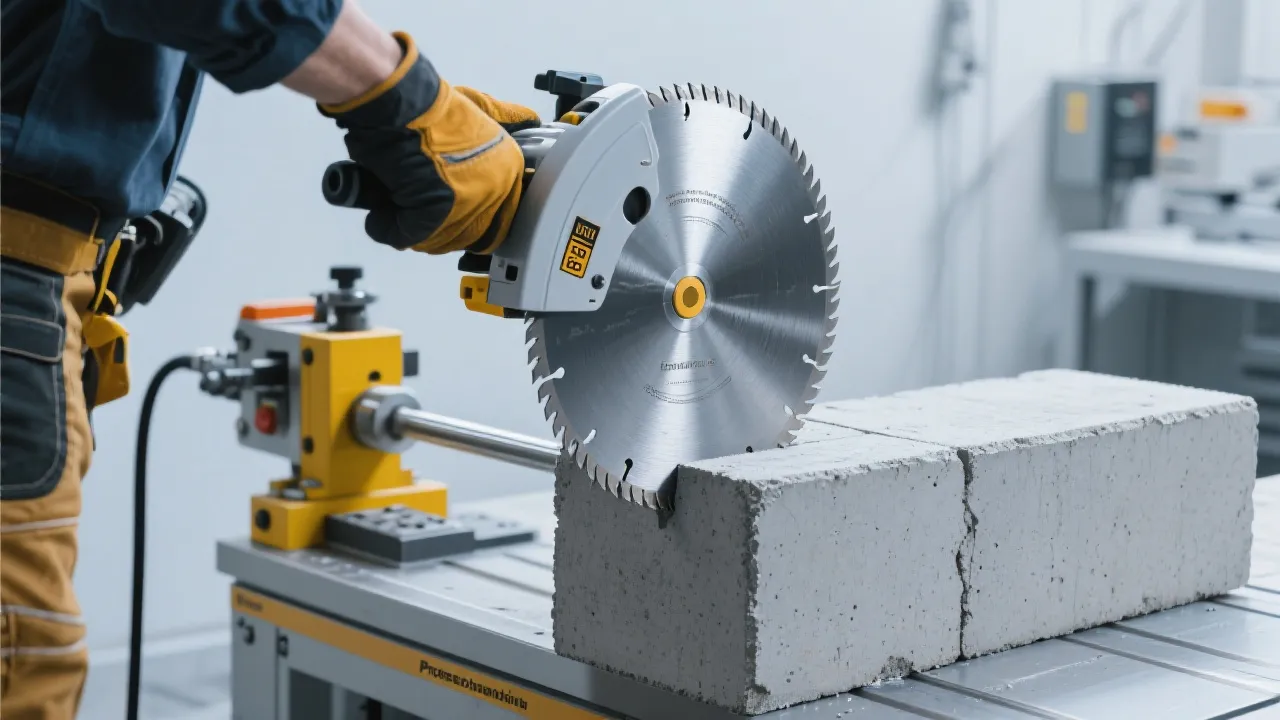
In the realm of industrial processing, the demand for high - performance cutting tools is ever - present. Vacuum brazing technology has emerged as a game - changer in the manufacturing of diamond cutting blades, addressing critical issues and providing efficient solutions. This article delves deep into the significance of vacuum brazing in diamond blade production and how it significantly improves the blades' wear resistance and service life.
Vacuum brazing is a complex process that involves joining two materials using a filler metal. In the context of diamond blades, the fundamental principle centers around creating a strong bond between the diamond particles and the blade substrate. The process starts with carefully selecting the right filler material. The filler's melting point is crucial, typically ranging from 800°C to 1200°C depending on the specific requirements of the diamond and the substrate.
The vacuum environment plays a vital role in vacuum brazing. A high - quality vacuum, usually maintained at a pressure of 10⁻³ to 10⁻⁶ Pa, helps to eliminate impurities and prevent oxidation during the brazing process. As for filler composition, alloys such as copper - based or silver - based materials are commonly used. By adjusting the ratio of elements like titanium, nickel, and chromium, the wetting ability of the filler metal to the diamond particles can be enhanced, which is essential for a strong bond.
Process parameters, including heating rate, holding time, and cooling rate, also need to be precisely controlled. For example, a heating rate of around 5 - 20°C/min allows for uniform heating, reducing the risk of thermal stress cracking. A suitable holding time, typically between 5 - 30 minutes, ensures that the filler metal fully melts and spreads evenly over the joint area.
Vacuum brazing enables a high - strength bond between diamond particles and the substrate through a chemical reaction. The active elements in the filler metal react with the diamond surface, forming carbides that anchor the diamond firmly to the substrate. Compared to traditional mechanical fixation methods, the shear strength of the bond created by vacuum brazing can reach up to 300 - 500 MPa, providing a more reliable connection.
When compared with traditional brazing techniques, vacuum brazing offers distinct advantages. In terms of wear resistance, diamond blades produced by vacuum brazing can withstand up to 3 - 5 times more abrasive wear. The service life is also significantly extended. Traditional brazed blades may need to be replaced after cutting 100 - 200 linear meters of hard materials, while vacuum - brazed blades can cut up to 500 - 1000 linear meters before replacement. Additionally, vacuum brazing provides better stability, reducing the risk of diamond particle shedding during high - speed cutting operations.
Vacuum - brazed diamond blades find extensive applications in heavy - duty cutting of hard materials such as building stone, ceramics, and concrete. In the construction industry, these blades are used for cutting large - scale stone slabs for facades and floors. In the ceramic manufacturing process, they are employed for precise cutting of ceramic tiles. In concrete cutting, vacuum - brazed blades can quickly and accurately cut through reinforced concrete structures, improving work efficiency and reducing labor costs.
In industrial processing sites, several practical suggestions can enhance the cutting performance of vacuum - brazed diamond blades. First, proper tool selection based on the material hardness and cutting requirements is crucial. Second, using appropriate coolant during cutting can reduce the temperature at the cutting edge, preventing premature wear of the diamond particles. Third, regular inspection and dressing of the blade can ensure the sharpness and cutting efficiency.
Numerous case studies and empirical data have demonstrated the technical and economic benefits of vacuum brazing technology. For example, a construction company in Europe reported a 30% increase in cutting efficiency and a 40% reduction in tool replacement costs after switching to vacuum - brazed diamond blades. These data clearly show the positive impact of vacuum brazing on industrial production.
This technology is also backed by the cooperation between the company and Henan University of Technology. Such industry - university - research cooperation not only provides strong theoretical support but also ensures continuous innovation and improvement of the technology.
If you are looking for high - performance diamond tools to solve your industrial processing challenges, look no further. Our vacuum - brazed diamond blades offer superior cutting performance, long - lasting durability, and excellent cost - effectiveness. Click here to learn more about our tool solutions and take your industrial processing to the next level! You can also contact us at [Contact Information] for personalized advice.
.png?x-oss-process=image/resize,h_1000,m_lfit/format,webp)


.png?x-oss-process=image/resize,h_1000,m_lfit/format,webp)