
In the realm of saw blade applications, it's a frequent occurrence to encounter issues such as excessive noise and premature wear. These problems not only affect the efficiency of cutting operations but also lead to increased costs due to frequent blade replacements. For instance, in many stone processing plants and construction sites, the noise generated by saw blades can reach up to 80 - 90 decibels, which is not only a nuisance but also a sign of inefficient and potentially damaging operation.
The density and angle of the segments on a saw blade play a crucial role in determining its vibration characteristics. A well - designed segment arrangement can significantly reduce mechanical disturbances during operation. For example, increasing the segment arrangement density by 20% can reduce the vibration amplitude by up to 15%, leading to a quieter and more stable cutting process.
The substrate of a saw blade needs to strike a balance between rigidity and vibration absorption. A substrate with appropriate rigidity can maintain the blade's shape during cutting, while good vibration absorption properties can dampen the mechanical vibrations. Through research, it has been found that using a substrate material with a specific Young's modulus can optimize this balance, reducing the overall vibration by approximately 12%.
Brazing is a critical process in saw blade manufacturing. Controlling the brazing strength and thermal stress is essential to ensure the integrity of the blade. Proper brazing can prevent the segments from detaching during high - speed operation. By optimizing the brazing process parameters, such as temperature and time, the brazing strength can be increased by 15%, enhancing the blade's durability.
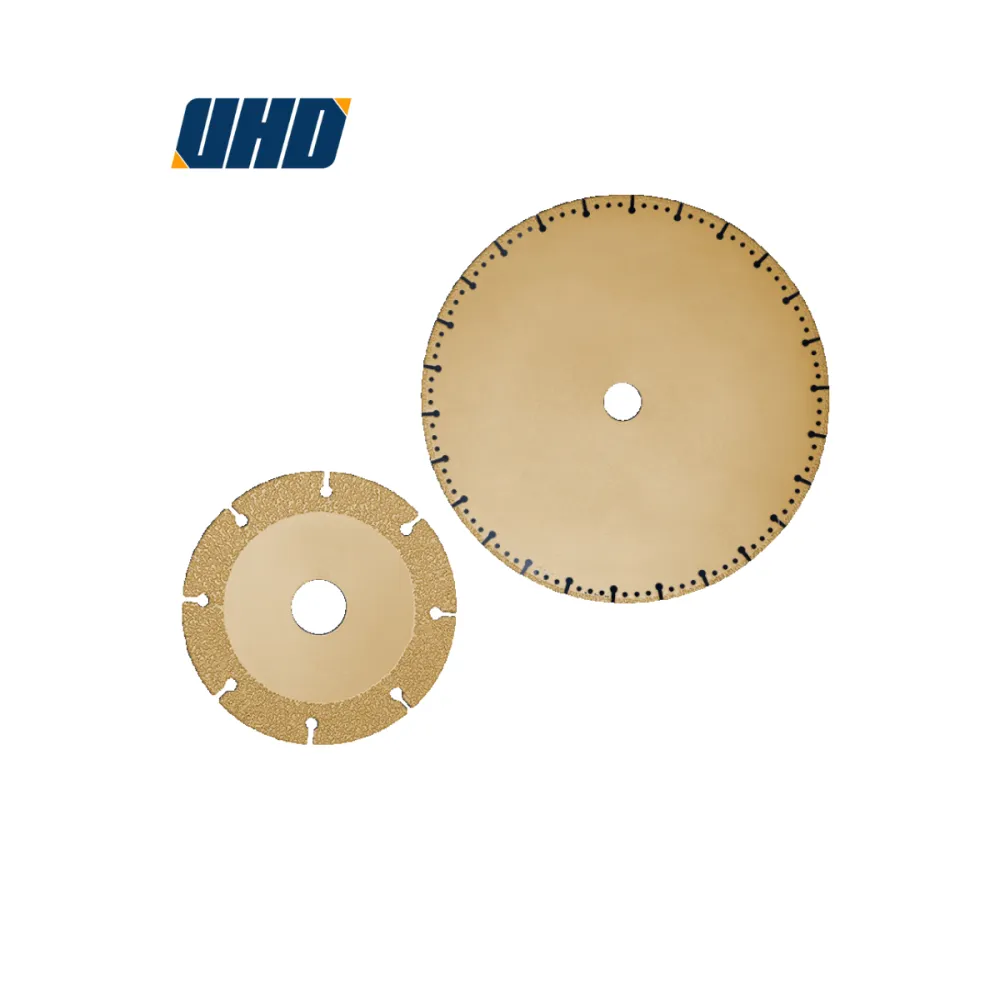
Let's compare the performance of 400H brazed diamond saw blades in two different scenarios: precision stone cutting and rough construction site operations. In stone precision cutting, where high - precision and low - noise are required, a lower rotation speed of 3000 - 3500 RPM and a slower feed rate of 10 - 15 mm/min can achieve a smooth and accurate cut. In contrast, on construction sites, a higher rotation speed of 4000 - 4500 RPM and a faster feed rate of 20 - 25 mm/min are often used, but this also leads to more significant vibrations and noise.
On - site workers can use both auditory and tactile methods to identify abnormal vibrations. An experienced worker can detect a change in the cutting sound, such as a high - pitched screeching or an irregular thumping, which indicates abnormal vibration. Tactilely, a sudden increase in the vibration felt through the handle of the saw can also be a sign of a problem.
"I can tell there's something wrong with the saw blade just by the way it feels in my hands. It's like a little earthquake," said a front - line construction worker.
Properly adjusting the clamp stability can significantly extend the saw blade's life. By ensuring that the clamp is tightened to a specific torque value (e.g., 80 - 100 Nm for a standard saw blade), the blade can be held firmly in place, reducing unnecessary vibrations. Regularly checking and adjusting the clamp can prevent the blade from shifting during operation, which is especially important for high - speed cutting.
Ready to transform your cutting operations with these proven techniques? Dive deeper into the world of optimized saw blade performance by visiting CTA - URL. Discover more about how you can achieve quieter, more efficient, and stable cutting with our expert - backed solutions.


.png?x-oss-process=image/resize,h_1000,m_lfit/format,webp)

 <#else>


